Remembering Kristallnacht
Through a dramatic reading and new classroom resources, Tulsa’s Council for Holocaust Education is helping a new generation learn from the past.
For more than 30 years, the Council for Holocaust Education has worked to ensure that the lessons of the Holocaust are not forgotten. Founded in the 1990s by Tulsa resident and child Holocaust survivor Eva Unterman, the council hosts educational programs throughout the year, including an annual community commemoration of Kristallnacht, the “Night of Broken Glass.”
This year’s program will take a dramatic approach to remembering the events of Nov. 9 and 10, 1938, with a staged reading of Address Unknown, a historical novella by American writer Kathrine Kressmann Taylor. The free program will take place from 2 to 4 p.m. Nov. 8 at Congregation B’nai Emunah.
The reading will feature actors Tom Berenson and Kurt Harris portraying two longtime friends and business partners, Max and Martin, through a series of letters.

Kurt Harris
First published in Story magazine in 1938, Address Unknown follows the relationship between the two men as Martin returns to Germany and Max, who is Jewish, remains in America. Through their correspondence, Max begins to recognize the increasingly dangerous changes taking place in Germany as the Nazi regime gains power.
The novella quickly attracted national attention. Reader’s Digest published a condensed version in 1939, and Simon & Schuster published the story in book form that same year.
“It’s a story of revenge and how that destroys society,” says Janet Dundee, who is involved with the Council for Holocaust Education.
For Dundee and others involved with the council, the story provides an opportunity to connect a historical event to issues students may encounter in their own lives.
A Turning Point in History
Kristallnacht marked a dramatic escalation of Nazi persecution of Jewish people in Germany and Austria. On Nov. 9 and 10, 1938, Nazi forces and others attacked Jewish homes, businesses and synagogues. Buildings were destroyed and windows were shattered, giving the event its name, “Night of Broken Glass.”
Jewish people had already been stripped of many rights under the Nuremberg Laws, which restricted their citizenship and participation in German society. During and following Kristallnacht, Jewish men were arrested and sent to concentration camps.
The events of those two nights are widely recognized as a major turning point in the Nazi persecution of Jews, which ultimately resulted in the murder of 6 million European Jews during the Holocaust.
A Survivor’s Legacy
Unterman knows the history personally.
As a 7-year-old child, she and her family were forced into a ghetto. Eventually, she and other members of her family were separated. She survived the Holocaust and was liberated with her parents on May 8, 1945, the day World War II ended in Europe.
After eventually settling in Tulsa, Unterman spent years without publicly discussing her experiences. Like many Holocaust survivors, she rarely spoke about what had happened, even with family members.
That changed when a teacher discovered her story and invited her to speak to his students.
That experience inspired Unterman to establish the Council for Holocaust Education, bringing together both Jewish and non-Jewish members to promote Holocaust education and invite speakers to the community.
Today, Unterman is 94. While she no longer regularly speaks in classrooms, the educational work she began continues through the council and its community partners.
Bringing the Lessons Into Classrooms
The council also works with educators to bring Holocaust education into Oklahoma classrooms. In 2022, Oklahoma lawmakers passed Senate Bill 1671, requiring Holocaust education for public school students in grades six through 12. The law calls for instruction that helps students understand the causes, course and effects of the Holocaust while also encouraging discussion about the ramifications of bullying, bigotry, stereotyping and discrimination.
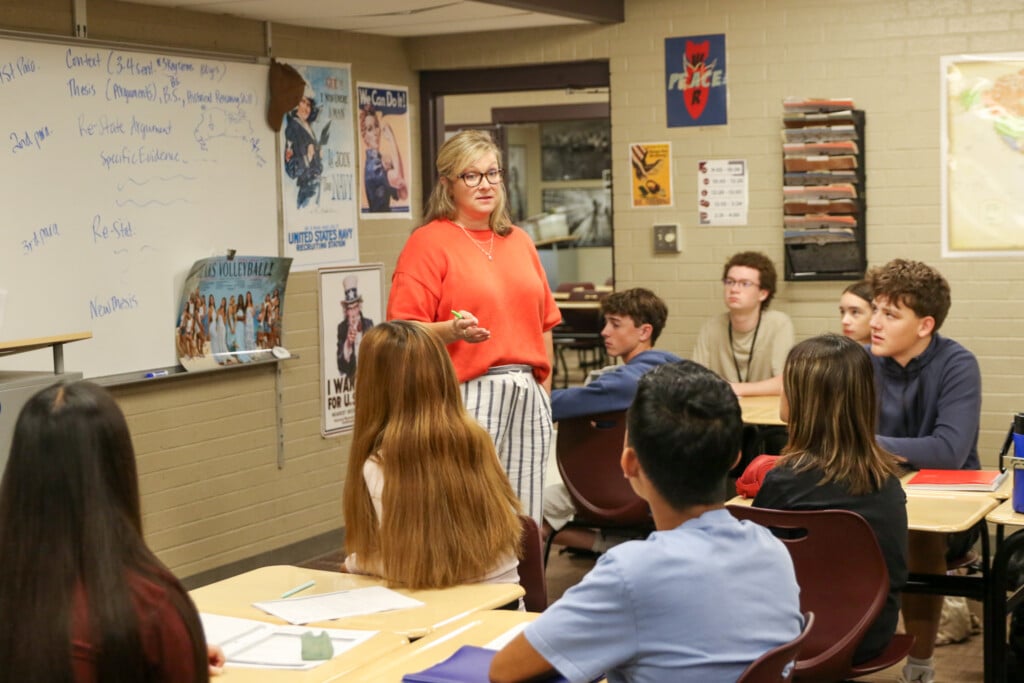
This year, Jenks teacher and Council for Holocaust Education member Christina Henson has developed a curriculum around Address Unknown for students in grades six through 12. Through the council’s Talk Back program, Tulsa-area teachers can borrow classroom sets of the book for two weeks and use Henson’s accompanying background information, discussion points and activities with their students.
The program extends the lessons of the Kristallnacht commemoration beyond the Nov. 8 event and into local classrooms.
Dundee says one of the most important lessons students can take from Holocaust education is learning how to recognize bullying and hate — and how to become an “upstander,” someone willing to stand up for another person when something is wrong.
“We want to remember so as not to forget,” Dundee says.
The council’s goal is not simply to teach students what happened in the past, but to help them consider how those lessons apply to their lives today, including issues of bullying, human rights and standing up for others.
The Nov. 8 event is intended for anyone interested in learning more, with the council recommending it for children age 12 and older. There is no charge to attend, although advance registration is required.
For Dundee, remembering Kristallnacht is ultimately about recognizing that history is not as distant as it may seem.
“History teaches us that things like this can happen in our civilized world,” she says. “We have to be aware of it and stand up against it.”
The hope is that learning about the past will give young people the courage to speak up when they see injustice in the present.
Kristallnacht Commemoration
What: A dramatic reading of Address Unknown by Kathrine Kressmann Taylor, performed by Tom Berenson and Kurt Harris
When: 2-4 p.m. Nov. 8
Where: Congregation B’nai Emunah, 1719 S. Owasso Ave., Tulsa
Cost: Free
Recommended age: 12 and older
Advance registration is required at tulsagogue.com/kristallnacht.

Tom Barenson
For Teachers
Tulsa-area educators can borrow classroom sets of Address Unknown for two weeks, along with curriculum materials designed for students in grades six through 12. Teachers interested in participating in the Council for Holocaust Education’s Talk Back program can contact Janet Dundee at jdarby55@aol.com for scheduling and additional information.
 Lindsay Morris is a native Tulsan, writer and founder of Tulsa Places, where she highlights local businesses and family fun. She works in healthcare marketing and communications.