Fiddle Around
Local young musicians prepare for the Oklahoma State Fiddling Championships
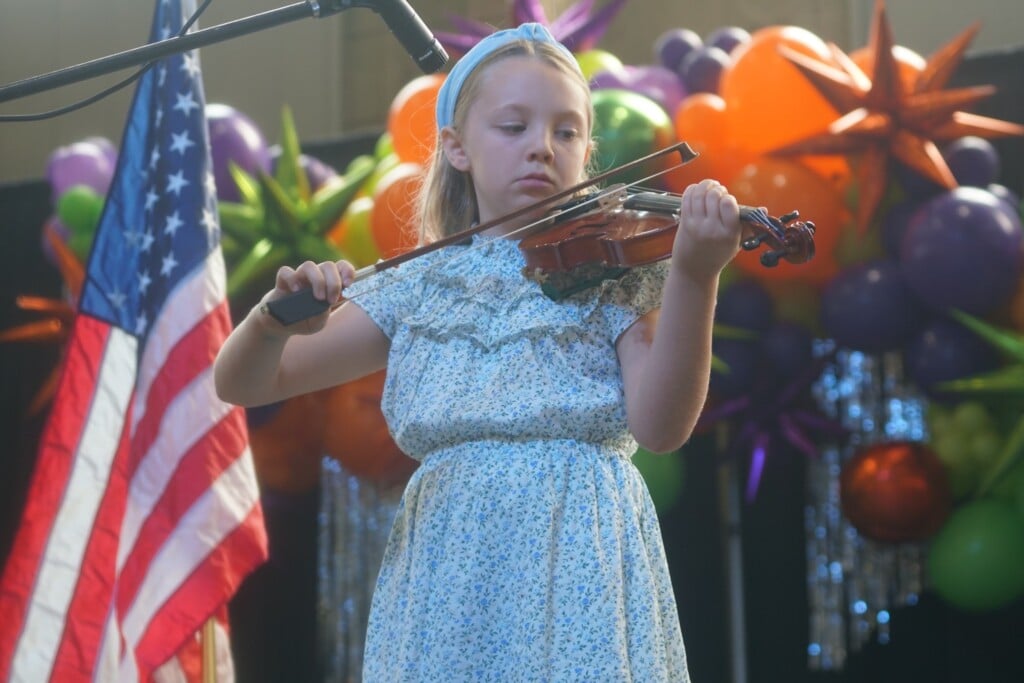
“The violin sings. The fiddle dances.” That old saying draws the distinction not between instruments—they are the same thing—but the music performed on them: classical versus so-called “alternate styles” like jazz, Celtic, swing, old-time, Cajun, klezmer and more.
What do students of one style have to gain by dabbling in another? That question was put to several noted Tulsa-area musicians who have long experience in fiddling, classical or both.
Shelby Eicher does not have a classical background but is accomplished in fiddle styles ranging from gypsy jazz to Western swing. He moved from Ohio to Oklahoma to attend a college with a bluegrass program, then was a member of Roy Clark’s country band for 15 years.
Eicher gives lessons not only in person but online to fiddlers as far away as Canada, including professional classical violinists. He notes that his classically trained students were taught to “play it right” rather than experiment and improvise.
“They’ve never used that part of their brain,” he says.

Shelby Eicher
Growing up, Rick Morton had never heard of country or bluegrass music. He learned the violin like other Tulsa Public Schools fifth graders — in orchestra class. His first performances were Bach and Vivaldi compositions. When Morton left high school, he figured he was done with music and abandoned his violin at school. Several years later, he says, his mother retrieved it and found a fiddle teacher for him.
He wound up playing fiddle on The Tractors’ 1994 Grammy-nominated, double-platinum-selling debut album. Bluegrass legend Vassar Clements became Morton’s biggest inspiration, yet he still plays around with classical music and performs with local country bands.
Morton urges young fiddlers to learn to sight-read. “Fiddle tunes are as complicated as classical,” he cautions. Learning one note at a time by ear because a student can’t sight-read “will take a while.” Each style demands its own techniques, he adds.
“Don’t play classical like you play fiddle—sliding where you shouldn’t be sliding. I want to play it like they wrote it.”

Scott Pendleton accompanies a young fiddler on his guitar
The Best of Both Worlds
Jana Jae is an accomplished fiddler and classical violinist.
“Don’t draw a line between styles. Don’t put yourself in a box,” she recommends.
Jae recalls performing as a child for a Lions Club meeting. Her classical numbers received polite applause. Her surprise finale, “one of granddaddy’s hoedowns,” brought down the house.
“Fiddle tunes are fabulous encores,” she says.
Jae has always had a foot in both worlds. Not only did her grandfather play old-time fiddle tunes, but her parents were classical violin students at Juilliard. She learned from them all. At age 5, she played a Brahms composition on the Ted Mack Amateur Hour television show—and won.
As a young teacher, she started a high school orchestra program that instantly attracted hundreds of students. On the fiddling side, she has been the female national champion. She became the first female instrumentalist in a country band when Buck Owens hired her. They performed live and on the long-running Hee Haw television show.
These days, Jae hosts a fiddle contest in June and a fiddle camp over Labor Day weekend. The variety of teachers and instruction at her fiddle camp allows musicians to put a toe in many waters.
“I always encourage people to expand their abilities, to listen to and learn to play several styles of fiddling. Stay true to each style with its own bowings and rhythms,” Jae says.
Over the years, Eicher, Morton and Jae have all judged the Oklahoma Fiddle Championships.
Different Styles, Different Skills
At age 7, Corbin Bodley began taking Suzuki method classical lessons infused with Irish fiddling from Tulsa’s Eric Ryan Johnson. Bodley went on to obtain a bachelor’s degree in violin performance from the University of Tulsa. Now a member of the Tulsa Symphony, he also plays fiddle gigs and teaches occasionally.
“Classical training is the best foundation you can get” but omits some things, Bodley says. A traditional melody played with classical technique “sounds too square” and “doesn’t get to the character” of the tune.
For their part, fiddlers have to “unlearn” some techniques such as playing with “a heavy hand” when performing classical music.
How to get into fiddling? Start by asking if your classical teacher plays other styles. Jocelyn Khalaf is one who does. Another is Karen Harmon, who not only teaches classical and runs the 65-member Tulsa Honors Orchestra, but also has belonged to an Irish band for 30 years. The current Oklahoma Pee Wee division fiddling champ is Harmon’s student.
Though she’s mainly a classical teacher, Harmon says, “I go with the student, what they think is fun.”
Taking the Stage
The Oklahoma State Fiddling Championships, hosted by the Tulsa State Fair for more than 50 years, offer young musicians a chance to see or try a different style of violin playing.
Classical students are accustomed to sight-reading while seated in an orchestra. At the fiddling championships, in contrast, they will see young fiddlers stand alone onstage in front of a microphone and dish up from memory a sizzling tune like the “Cotton Patch Rag.”
The contest is designed to attract and reward novices as well as experienced fiddlers. There are separate divisions for ages 8 and younger, 9 to 12, and 13 to 17.
Teachers invariably cite one particular benefit of a contest. It is a date on the calendar that nudges a student to practice.
“There’s no downside to that,” says Eicher, one of last year’s judges.
When Sicily Creekpaum won last year’s Pee Wee division at the Oklahoma State Fiddling Championships, she received a cash prize and a trophy belt buckle. Creekpaum likes to wear her buckle on special occasions such as other fiddle contests, dad Kyden says. With her prize money, she bought an American Girl doll miniature violin set so she and her doll can practice together.
Fiddle or Violin?
The violin and fiddle are essentially the same instrument—it’s how you play it that makes the difference.
VIOLIN
- Often associated with classical music
- Music is commonly read from a score
- Classical training emphasizes technique, precision and interpretation
- Often played as part of an orchestra or ensemble
FIDDLE
- Associated with styles including bluegrass, Celtic, old-time, country, Cajun and Western swing
- Tunes are often learned by ear and played from memory
- Rhythm, stylistic bowing and improvisation may play a larger role
- Often played solo or with a small group
Oklahoma State Fiddling Championships
When: October 3, 2026
Where: Tulsa State Fair
Youth divisions: Ages 8 and younger, 9-12 and 13-17
Prizes: Cash awards for the top 10 finishers in each youth division, with a trophy belt buckle for first place
Pre-registration: Register online before Sept. 14 to receive the reduced $10 entry fee, a free Tulsa State Fair ticket and a souvenir T-shirt.
Contest rules, registration information and prize breakdowns are available at the Tulsa State Fair website.
Scott Pendleton is a writer and longtime musician who has spent the past 25 years playing guitar and exploring Oklahoma’s music scene. He has also tried his hand at fiddling, once earning third place in the senior division at the Tulsa State Fair.