Union Robotics Students Help Classmate
At Union’s Darnaby Elementary School, a group of elementary students is using robotics to help a classmate navigate her world. Their project, “Sound Scout,” is designed for a 6-year-old student who is blind and uses a wheelchair—creating a way for her to move through her classroom more independently and confidently.
The project began when the school’s robotics club was approached by a district physical therapist with a unique request: create an audible cue to alert a student when objects are too close to her wheelchair. Students in both the robotics club and a 3D modeling tech club began exploring ways to help a bright and curious classmate who loves music, exploring her surroundings and spending time with friends. Currently, she navigates by slowly propelling her wheelchair forward until she encounters an obstacle, then backing up to correct course.
Her classmates saw an opportunity to make that process easier. Using VEX Robotics components, distance sensors and 3D-printed parts, they’re building a system that detects nearby objects and translates that information into sound cues—giving her real-time feedback as she moves.

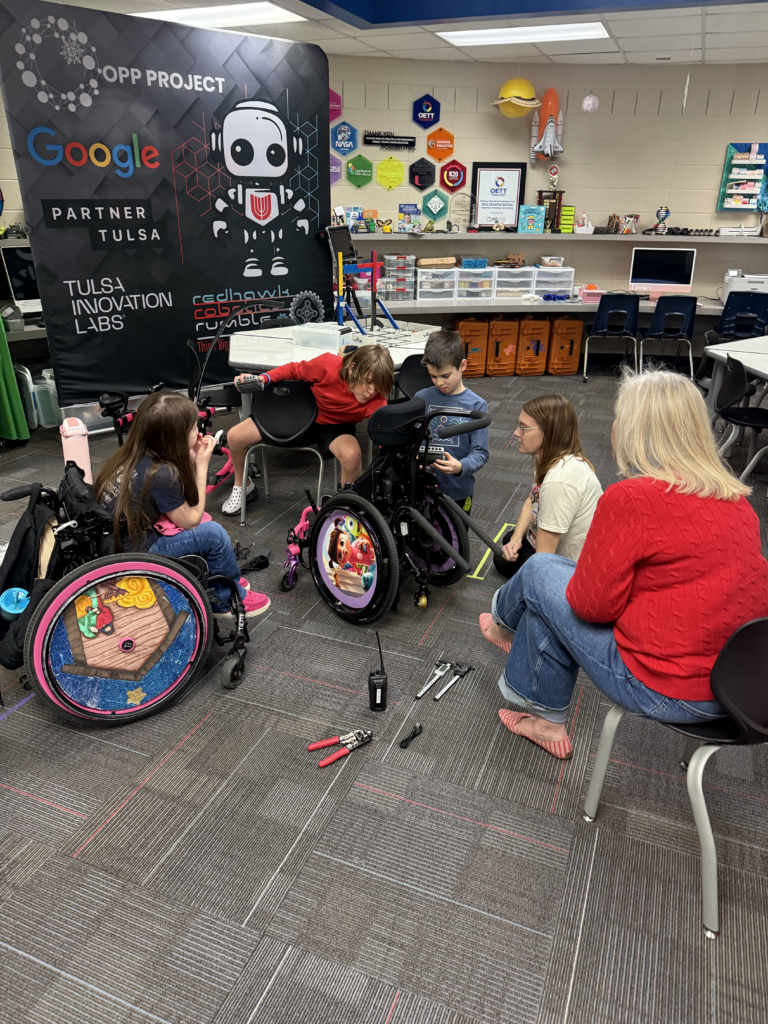
A student works with Physical Therapist Megan Lee to place one of the Sound Scout sensors on the wheelchair.
Photo by MacKensie Mathison
For the students behind Sound Scout, the project is as much about helping a friend as it is about coding and engineering. They’ve spent weeks testing ideas, troubleshooting designs and thinking through what would actually make a difference in her day.
“This project is about more than technology,” says MacKensie Mathison, STEM strategist at the school. “It’s about building empathy, sparking creativity and empowering students to see how their STEM skills can be used to solve real problems and make a meaningful difference in the lives of others.”
The project is part of an afterschool STEM initiative supported by The Opp Project and a $75,000 investment from Google, which has expanded robotics clubs to schools across Tulsa—showing students how their ideas can make a real impact close to home.