Melissa Phenicie: Creating a Community of Encouragement, Purpose and Belonging
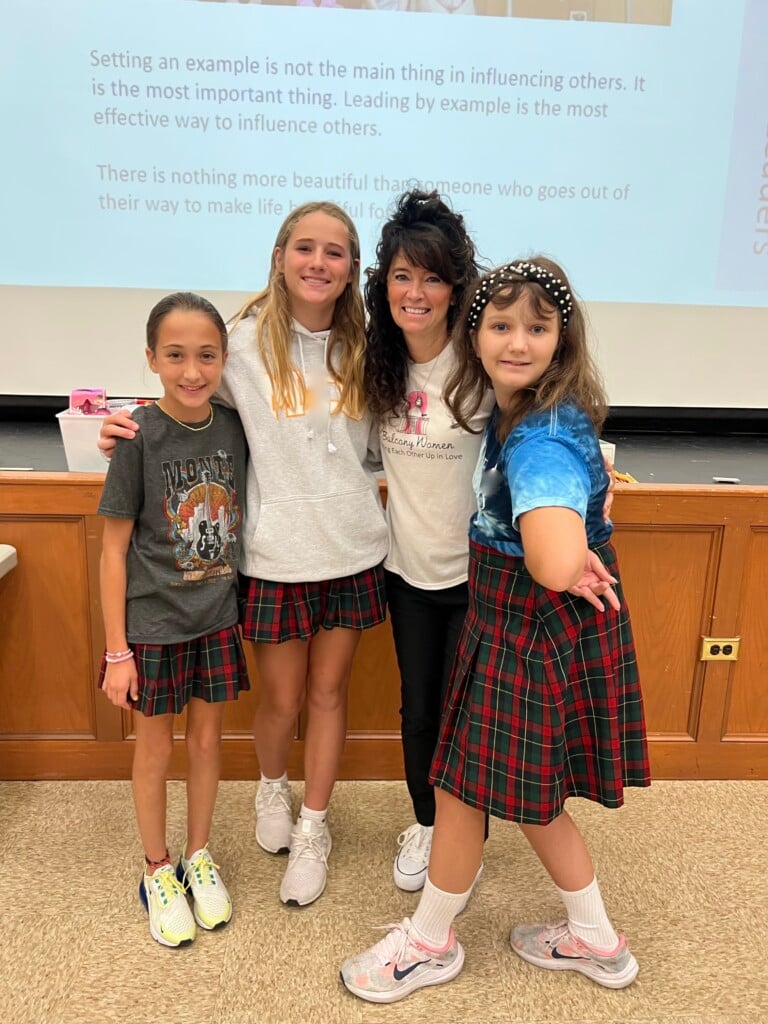
What began as a desire to help young people and widows in Melissa Phenicie’s own life has grown into a powerful community known as Balcony Women. This multigenerational nonprofit equips young men and women to recognize their unique gifts and lift one another up while restoring hope and belonging to widows. The organization has grown into a team of volunteers who provide mentorship, youth workshops and transformative gatherings for widows. During this visit, Melissa shares the defining moments that led her to step outside of her comfort zone to start Balcony Women, the vision behind creating a full-circle community of encouragement and why each of us has the ability to become balcony people—cheering and supporting others.
TK: How did Balcony Women begin?
Melissa: Balcony Women is a nonprofit that equips people to uplift and encourage others through mentorship and community—especially widows and youth, so no one walks alone. We equip them to recognize and use their given gifts and talents.
This idea was planted during a time when I had young people in my life who were dealing with anxiety and bullying. I am an educator by profession, and their parents were hoping I had solutions. I also had widows in my life on a roller-coaster grief journey who needed guidance. I just wanted to help, and through some research, found nothing to support the youth or the widows. This was the beginning of my journey of learning my purpose.
TK: You talk about people standing in the balcony cheering others on. Who were the balcony people in your life?
Melissa: God always surrounded me with Balcony Women growing up. I was blessed with a mom, grandmothers, aunts who all supported me. I was lucky to have a small group of girls in high school and college who wanted the best for me. I married into a family where my mother-in-law and grandmothers also supported me. It wasn’t until I was an adult that I had an experience that opened my eyes and heart to the realization that not everyone is as fortunate. I began to look for other Balcony Women in my community and worked to set an example of how women could be Balcony Women. I didn’t realize how big my circle of influence would become.
TK: Was there a specific moment when you realized this wasn’t just an idea—but a calling?
Melissa: I remember having a hard day. I was having my own private pity party. Asking questions like, “Why aren’t people doing anything to help these young people understand that they are created with all these gifts and talents for a purpose and that they would be happier if they helped each other instead of hurting each other,” and “We are supposed to take care of the widows in our community, but no one is doing it. Why?”
I went to bed frustrated and defeated. I had a dream that night that I was this big bird crammed in this small cage. I liked the cage because it was my comfort zone. I could control everything in the cage, but I wasn’t fulfilling my purpose. I was to get out of the cage and my comfort zone to help our youth and our widows. I didn’t know how, but I knew that was my purpose. I wear a bird necklace every day to remind me of my purpose and if ever I feel like getting back into my cage, I remind myself that it is not an option.

Women supporting women: Nearly 700 Tulsa-area women attended the last Balcony Women dinner for widows.
TK: Tell us about your programming.
Melissa: Programs for widows include monthly support groups where they learn tools to help them on their grief journey, and two large yearly events that provide fellowship and community. We just hosted our Valentine’s events and had 690 widows RSVP. Widows often say that walking into a room with hundreds of others helps them realize they are not alone. We also have partnerships with YMSL (Young Men’s Service League) and NCL (National Charity League) that help meet everyday needs such as yard work or small projects around the house and sending the widows birthday cards.
The Balcony youth workshops teach middle school-age youth nine character skills: character, purpose, power of words, happiness vs. joy, truth over feelings, friendship vs. crowd, screentime, set apart and conflict resolution.
TK: Today, kids face immense pressure to perform, compare and compete. What do they need most from us as mentors?
Melissa: We have many mentors who teach but do not model. Our youth pick up on that quickly and follow what we model more than what we teach. Mentors offer belonging, spiritual grounding, practical tools and steady encouragement so our youth learn to thrive without competing for worth. Good mentors provide presence and unconditional support, help young people discover their God-given identity and gifts and equip them with emotional tools. A sweet workshop attendee shared something she learned at our workshop, “Happiness is not a forever feeling. Many things—even things that are not good for me—can bring me happiness, but it won’t last. I want joy. I want to focus on things that bring joy so no matter what I am going through I can have joy.”
TK: Why is it important for young people to understand their identity and value early?
Melissa: Understanding identity and value early helps young people grow with confidence, purpose and make healthier choices. When kids know they are created with unique gifts and a God-given purpose, they stop measuring worth by performance or comparison.
After one of the workshops, I had a 12-year-old girl come up to me and say, “I get it now. I am not weird. God made me this way for a reason.” She left the workshop ready to use what others saw as weird to fulfill her purpose. She even told the principal that was her best day ever. You know from her statement that her peers had been telling her that she is weird and different because she didn’t fit in their box. I am certain that troubled her, but now she knows there is nothing wrong with her.
TK: How can people get involved?
Melissa: If you want to volunteer at our events, email us at volunteer@balconywomen.com, and we will add you to our volunteer email that goes out prior to our events. To host a school workshop or group event, email melissa@balconywomen.com.
More with Melissa
Laughter and Lemonade, the next dinner to support widows, takes places July 23. Find out more at balconywomen.com.
To hear more about Melissa’s journey, listen to the Sharing Passion and Purpose podcast at NancyMoore.co/podcast.
 Nancy A. Moore is an adjunct professor at Tulsa Community College and has been a writer for TulsaKids for more than 20 years. Her podcast, Sharing Passion and Purpose, can be found on most podcasting platforms or on NancyMoore.co.