Tej Beniwal: From Backyard Birding to Big Impact
Tej Beniwal is a senior at Jenks High School with a passion for bird conservation and connecting people to nature. What started as backyard birding has grown into leadership roles with the Jenks Birding Club—which he founded—and volunteer work with the Tulsa Audubon Society. Through outreach, education and advocacy efforts like Lights Out Tulsa, Tej helps raise awareness about bird-window collisions and ways the community can better protect migrating birds. Outside of birding, he leads the Jenks HOSA chapter (Future Health Professionals) and works as a chemistry research intern at the University of Tulsa. You can follow Tej’s bird photography on Instagram @thewondersofcasualbirding.

TK: How did you first get interested in birding?
Tej: My passion started with my mom’s old camera and a field guide she bought, discovering birds in our backyard and on hikes. I found that once you begin noticing birds, their once hidden world becomes impossible to ignore. It grew even more when I visited my dad’s hometown in India and met a local birder who showed me incredible, hidden places full of wildlife. Seeing birds in such different parts of the world made me realize how special and universal birding is.
TK: Do you remember the first bird that really made you stop and pay attention?
Tej: A male Northern Cardinal. One of the most common backyard birds, but its bright red color is hard to miss.
TK: Where are your favorite places around Tulsa to go birding?
Tej: Oxley Nature Center is definitely my number one place to go birding in Tulsa. Ray Harral Nature Center, Turkey Mountain and Haikey Creek Park are also some of my favorites.
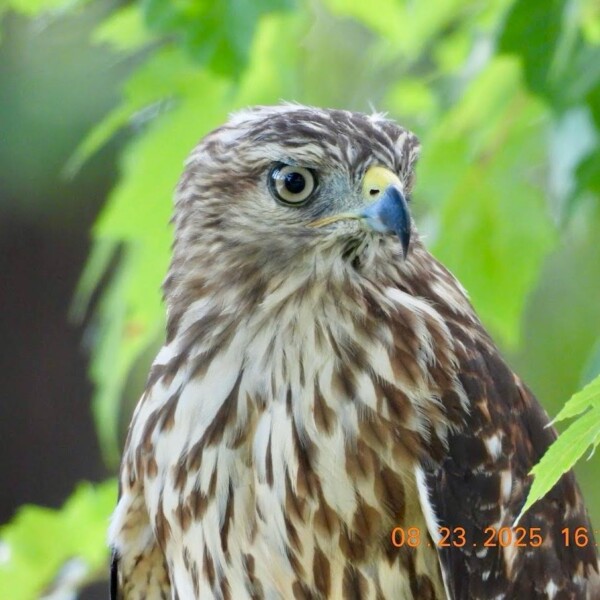
Red-shouldered Hawk. Photo by Tej Beniwal
TK: What does a typical birding outing look like for you?
Tej: Early morning hike at a local park with my friends or family with some doughnuts, binoculars and my camera. Roam around and take pictures till we get hungry or the birding dies down.
TK: Why are Purple Martins important, and what does caring for them involve?
Tej: Purple Martins are important because they’re a native species that now rely on people for safe nesting spaces. Without maintained housing, their populations can decline, so taking care of them directly supports their survival. Caring for them involves maintaining the martin houses along the Flycatcher Trail by cleaning out old nests and removing House Sparrow nests, since sparrows are invasive and can take over the spaces. We also add pine needles to encourage Purple Martins to nest there. It’s simple but meaningful work that helps protect a species that depends on us.

TK: How did it feel to help with the Lights Out Tulsa Day proclamation? Why do you think turning off lights at night matters for birds?
Tej: It felt really rewarding to expand my work to an official citywide capacity. Knowing that “Lights Out Tulsa Day” is now observed every September 24 makes it feel like a permanent reminder for the city to think about birds and conservation.
Turning off lights at night matters because many birds migrate using the stars and moon. Bright city lights can disorient them, pulling them off course and into dangerous urban areas where they risk collisions and exhaustion. Reducing unnecessary lighting helps keep their migration safer and reminds people that small changes can make a big difference for wildlife.

Tej watches birds with friends from the Jenks Birding Club.
TK: Do your friends think birding is cool, or did they at first think it was kind of unusual?
Tej: At first, most of my friends definitely thought birding was unusual. The last time a lot of people my age had paid attention to birds was playing Angry Birds in elementary school, so the idea of waking up early just to look for them felt strange. But I really wanted to share how exciting it is, so I started inviting friends, sometimes bribing them with snacks, and talked to students in zoology and veterinary science classes who already loved nature. Once people actually tried it and lifted binoculars for the first time, their perspective changed. What started as weird slowly turned into something they found fun, especially as a group activity.
TK: What’s your favorite bird, and why?
Tej: The Secretary Bird. It kills its prey (usually snakes) by stomping on it—and just looks like it has an aura.
TK: Is there a bird you still really want to see someday?
Tej: Definitely the Painted Bunting. It’s a small bird, but one of the most colorful there is, with bright green, blue, red and orange feathers. It’s the most colorful bird that you can find in Tulsa, and one I’ve yet to spot.
TK: What’s something about birding that might surprise other kids?
Tej: I’d say people are surprised by how wide the variety of birds you can see is. Oklahoma itself has over 450 bird species! Compared to other wildlife, birds are much easier to spot and provide a very wide range of colors, sizes and songs.
TK: What would you tell other kids who are curious about birds or nature but don’t know where to start?
Tej: I’d say the easiest place to start is your own backyard. Set up a bird feeder, buy a cheap field guide, and you can start finding birds just by sitting on your porch. As interest sparks, buy binoculars to be able to see the birds up close.

Tej photographed this Lilac-breasted Roller at the Masai Mara National Reserve in Kenya.
TK: When you’re not birding or volunteering, what do you like to do for fun?
Tej: I love to play tennis, go to the gym, play my cello and watch TV!