Tools for Managing Neurodiversity
Between all of the autism, ADHD, and generalized anxiety disorder, our family makes for a pretty neurospicy crew. And while some medications can be very helpful, one thing we’ve learned is they don’t work like magic potions, instantly making all of the challenges we face manageable. That’s why we’ve worked really hard around here to find additional tools to help us navigate some of those challenges, emphasizing to the kids that self-management can be every bit as important as self-advocacy.
Today, I wanted to share some of the tools and tips we’ve learned to help navigate some of the self-regulation challenges we face both as individuals and as a family because they’re such an important part of how we manage our everyday lives.
1. Challenge: Remembering Appointments
Remembering appointments, meetings, events, and even things like requesting prescription refills has historically been a huge crisis point trigger for our family. Without exception, every member of our family struggles to retain key information because we get lost in the moment. I’ve had reminders on my phone for appointments that I turned off, thinking, “Oh, that’s just 15 minutes from now, I’ll definitely remember” and then immediately gotten caught up in some side quest of a side quest. You think you’re just going to pop your head in and check on the laundry, but somehow you ended up reorganizing all of the kitchen Tupperware, and you’re not even sure what flow chart brought you here.
And even though I’m decidedly not the most reliable person when it comes to remembering appointments, more often than not, the burden of household management falls to me as the mom — and y’all, it’s a heavy burden when you can’t stay focused on one thing for 15 minutes. It’s not like I can just ask someone else to handle it, either, since I’m still levels above everyone else in this house when it comes to keeping track of appointments.
But a missed appointment isn’t just an inconvenience to us. It can also be frustrating or even costly to the folks we’re bailing on, no matter how much we intended to not bail on them. Intent versus impact, amirite?
All that is to say that our family has put in a lot of work to find the right tools to help us manage appointments, events, etc. Everyone has their own personal preference, but there are a few tools we all rely on.
Solutions: Whiteboard Calendar, Family Google Calendar
To ensure we don’t miss any important events, we use a twofold system to manage our upcoming events. First, we use a family Google calendar that’s connected to all of our individual Google accounts. When something new is added, we send a text message to every family member the event applies to.
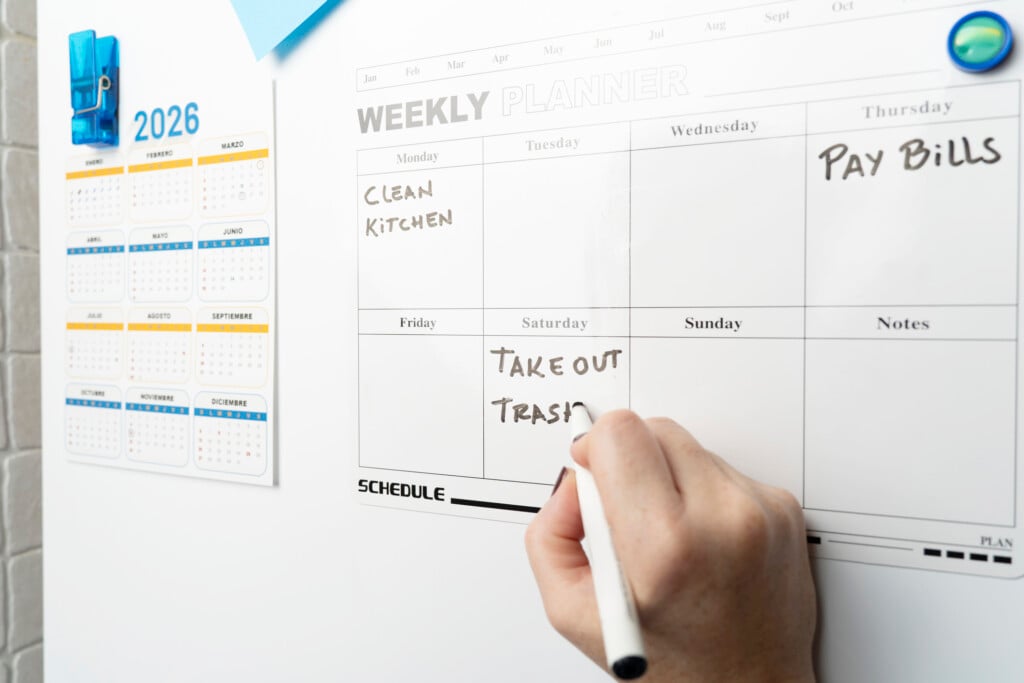
But because there tends to be an “out of sight, out of mind” component to ADHD and task management, we also keep a one-month whiteboard calendar in the shared living space of our home. Every once in a while, I also try to take time out to make sure they’re aligned and to remind everyone which events are coming up for our family.
2. Challenge: Task Follow-Through
I wish I could say that this is just a big deal for the kids in our family, but task follow-through really is an everybody issue. We all have those moments where we’re asked to do something else while we’re in the middle of doing something. It’s easy to say, “Sure, as soon as I finish this” and then, despite our best intentions, despite any post-it notes or reminders, immediately forget about that commitment.
This has been a huge point of frustration in the past because it has often added up to me taking on the heavier chore load since, by the time I’m reminding that person of their commitment, they’ve already moved on to another task. And realistically, it’s not ideal to have to remind teens, neurospicy or not, of the responsibilities they’ve agreed to when they’re old enough that they should be self-motivated to finish those tasks on their own. This can also be an issue when it comes to self-managing things like basic sleep hygiene or managing their own laundry; by the time they’re a teen, they really need to be doing this stuff on their own even if ADHD and autism make follow-through a challenge.
Solution: Phone Alarms
Our family basically runs on phone alarms to deal with basic task management. For me, it’s reminders to finish certain jobs, exercise, or call to check on things like dental appointments. For the kids, it might be a reminder to start winding down for bedtime, get an ROTC uniform ready, or stop working on whatever project they’re absorbed in and run the trash out to the curb.
3. Challenge: Communicating Important Information With the Family
Communication between family members has been an issue in our family since before we ever had kids. Everyone in this family is very distractible, and just like chores, it’s easy to get caught up in what we’re doing and forget to share key information with other members of the family. This can be a big deal when, say, an important package arrives, we’re out of some essential household item, or an appliance is deemed unsafe to use for some reason.
Solution: Family Group Chat
We have a family group chat that we use to communicate everything. Kids need a ride home from school because someone has a sore ankle and it’s too far to walk? Family group chat. Dinner request? Out of toilet paper? Dinner ready? Need someone to feed the cat? Family group chat.
Our family uses Facebook Messenger because it’s easy, and you don’t actually have to use the Facebook platform to use it since it’s a separate app (although you will need a Facebook account). Some families also use their SMS or Discord for this.
4. Challenge: Expressing Frustration
When you’ve got neurodiversity on board, impulse control and various social challenges can sometimes make tricky interactions even trickier. In our family, this can lead to folks struggling to communicate effectively without feelings getting hurt, which in turn can lead to an escalation of emotions.
Solution: Space
Anytime we’ve got hot feelings, the frustrated parties take a time out from each other with the goal of reconvening once we’ve had time to cool down a bit and think about the other person’s point of view. It sounds simple, but you’d be amazed at how many seemingly serious confrontations turn into, “Hey, I just wanted to let you know that I don’t like what you were saying to me earlier,” followed by a friendly agreement to respect boundaries once you’ve given some space.

ucpage/Getty
5. Challenge: Managing Clutter
Clutter is an endless struggle in our home because the ADHD brain wants to constantly start projects but doesn’t always finish them. We’ve accepted that we’re never going to have a Better Homes And Gardens-ready home, but we also can’t live surrounded by chaos and clutter. That’s led to what I like to think of as happy medium solutions.
Solutions: Clutter Gathering Points & Cleanup Dance Parties
To help manage the biggest clutter issues, we’ve established baskets and other gathering points for repeat offender clutter issues. In the front hallway, there’s a large basket for tossing shoes that might otherwise end up spread across the living room floor. In the main hallway, there’s a large coat tree and a bench for depositing backpacks, purses, and other items friends bring over when they visit. Right by the front door, there’s a basket for Arthur Clutter — that is, all of the manga, doodles, Nintendo DSes, and various other items Arthur carries in his pockets and then leaves strewn all over the house. And underneath the lamp table right inside of our living room, we’ve got a large basket for gathering miscellaneous electronic cords, plugs, controllers, and batteries that seem to be endlessly lying all over the living room.
About twice a week, when everyone is home, I crank up the music, plug in the subwoofer, and play Talking Heads’ “Psycho Killer” or Boney M.’s “Rasputin” — my two Lucy summoning songs — and then she grabs the brothers for a super intense cleaning session. For about 30 minutes to an hour, we all feverishly dust, clear clutter, and tidy up the primary living spaces together before going on our merry way to clutter it all up again.
What are your biggest issues as a neurodivergent family? Let me know how you manage them in the comments, and thanks for reading!